
Full grain, top grain, and split leather all come from the same hide — but they are not the same product. They perform differently, age differently, and suit different applications. Whether you are buying a leather sofa, sourcing hides for a craft project, or evaluating a leather jacket, knowing the difference will help you buy smarter and avoid paying premium prices for lower-grade material.
This guide explains exactly what each grade is, how they compare side by side, which is best for specific uses, and how to identify the grade of leather you are looking at.
How Leather Is Graded — Understanding the Layers
To understand full grain, top grain, and split leather, you need a basic understanding of how a hide is structured. When a hide comes from the animal, it has distinct layers:
-
The grain layer — the outermost surface, with the tightest, most densely packed fibers. This is the strongest and most durable part of the hide.
-
The junction layer — the transitional tissue between the grain and the inner layer.
-
The corium (flesh side) — the inner layer, with looser, more open fibers. This is where split leather comes from.
The decisions tanneries make about these layers determine what grade of leather is produced. The closer to the outer grain layer, the higher the quality and durability of the finished leather.
What Is Full Grain Leather?
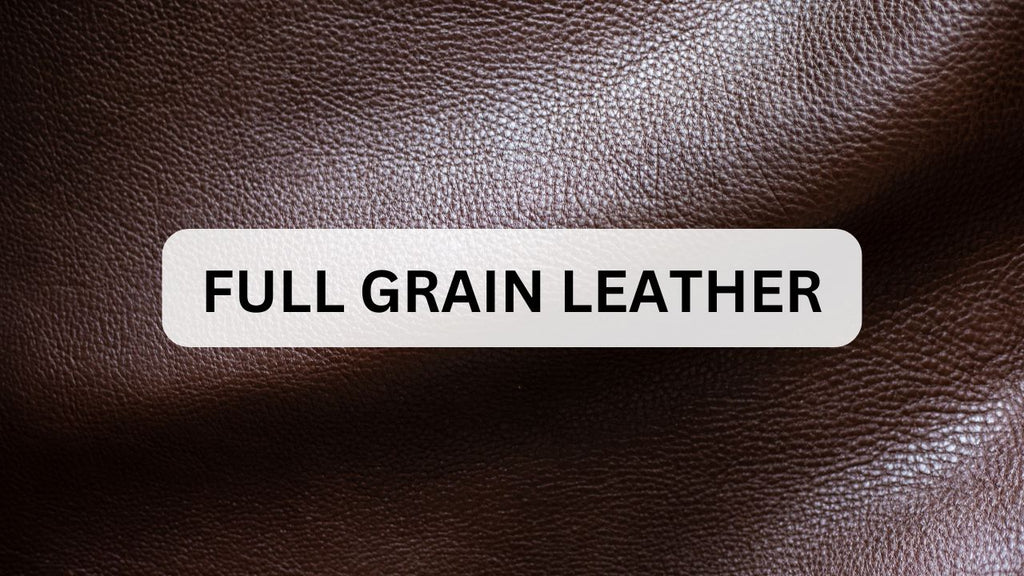
Full grain leather is the top layer of the hide with nothing sanded away. The natural grain surface is completely intact — including all the original texture, pores, and any natural markings from the animal's life (small scars, wrinkles, insect bites). Because nothing has been removed, full grain leather retains the hide's original strength, breathability, and fiber density.
Full grain leather is the highest quality leather available. It is the only grade that develops a true patina over time — a deepening richness of colour and texture that comes from oils, handling, and use. A full grain leather bag or wallet carried for ten years becomes distinctly yours.
Characteristics of Full Grain Leather
-
Durability — the strongest leather grade; the dense outer fiber layer resists cracking, tearing, and abrasion better than any other type
-
Patina development — the surface absorbs natural oils and develops depth and character over years of use
-
Breathability — natural pores remain open, making it comfortable for garments, gloves, and footwear
-
Natural variation — no two hides are identical; natural markings add authenticity and character
-
Water resistance — the intact grain surface provides better natural water resistance than processed grades
-
Price — the most expensive leather grade; higher-quality hides are required because imperfections cannot be sanded away
Characteristics of Full Grain Leather
-
Durability — the strongest leather grade; the dense outer fiber layer resists cracking, tearing, and abrasion better than any other type
-
Patina development — the surface absorbs natural oils and develops depth and character over years of use
-
Breathability — natural pores remain open, making it comfortable for garments, gloves, and footwear
-
Natural variation — no two hides are identical; natural markings add authenticity and character
-
Water resistance — the intact grain surface provides better natural water resistance than processed grades
-
Price — the most expensive leather grade; higher-quality hides are required because imperfections cannot be sanded away
What Is Top Grain Leather?
Top grain leather starts at the same place as full grain — the uppermost layer of the hide — but goes through an additional processing step. The surface is lightly sanded or buffed to remove natural imperfections: scars, healed wounds, texture inconsistencies. A finish coat is then applied to create a uniform, consistent appearance.
The result is leather that looks cleaner and more polished out of the box. It is more consistent from piece to piece, which makes it easier to manufacture with and preferred in applications where a flawless finish matters. Top grain leather is the second-highest grade and is still genuine, high-quality leather — far superior to genuine leather or bonded leather.
The trade-off: the sanding removes some of the tightest, most durable fibers at the very surface. The finish coat creates a barrier that is less breathable and less receptive to natural conditioning. Top grain leather ages well but will not develop the same rich patina as full grain.
Characteristics of Top Grain Leather
-
Appearance — smooth, uniform, and consistent; looks polished and refined from day one
-
Durability — genuinely durable, but slightly less so than full grain due to surface sanding
-
Patina — limited; the finish coat resists the development of natural patina
-
Maintenance — easier to clean because of the surface finish, but requires regular conditioning to prevent the finish coat from cracking
-
Versatility — ideal for luxury goods, desk accessories, dress shoes, and formal leather items
-
Price — more accessible than full grain while still delivering real leather quality
What Is Split Leather?
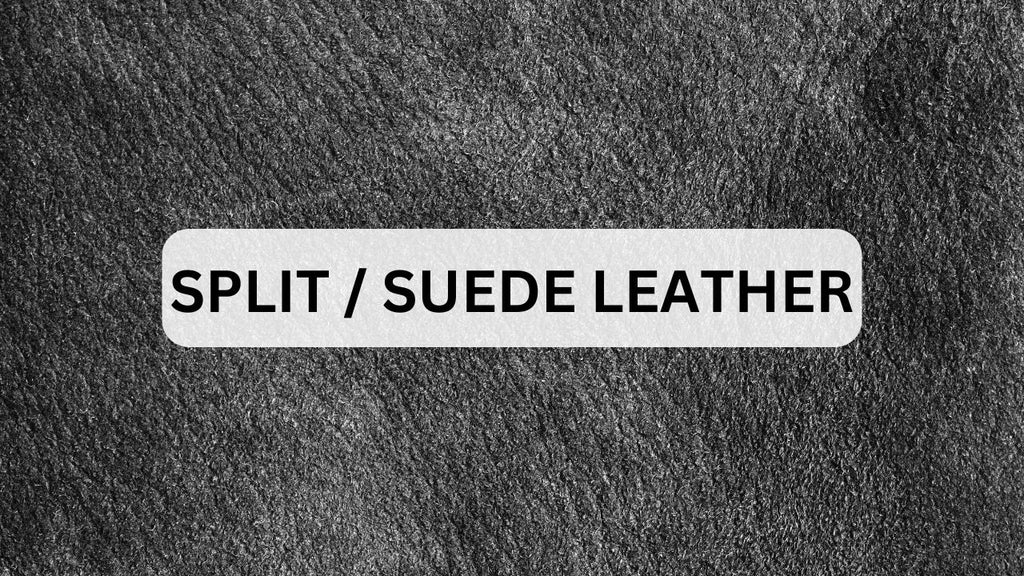
Split leather is leather made from the lower layers of the hide — specifically the corium (flesh side) that remains after the grain layer has been split off to make full grain or top grain leather. It is sometimes called the flesh split or simply the split.
After splitting, the collagen fibers on the flesh side are looser and no longer attached to the tight outer grain. Split leather therefore has a weaker structure than grain leather. To give it a presentable surface, split leather is typically coated with a synthetic layer and embossed with an artificial grain pattern using a printing press
Split leather is also the base material for suede — when the flesh side is buffed to create a soft, napped finish. This is an important distinction: not all suede is poor quality, but it does come from the split.
Characteristics of Split Leather
-
Cost — the most affordable leather grade; all parts of the hide are used, reducing waste
-
Softness — the corium layer has a naturally soft, open texture
-
Durability — the least durable grade; the looser fiber structure provides less strength and resistance
-
Surface — typically has an artificial grain applied via embossing; the surface can peel or flake over time as the coating degrades
-
Breathability — lower than grain leather due to the synthetic coating applied on top
-
Uses — furniture, automotive upholstery, shoes, bags, and products where cost and softness matter more than longevity
Full Grain vs Top Grain vs Split Leather — Complete Comparison
|
Property |
Full Grain |
Top Grain |
Split Leather |
|
Layer Used |
Outer grain — intact |
Outer grain — sanded |
Inner corium (flesh side) |
|
Quality Grade |
Highest |
Second |
Lowest |
|
Durability |
Excellent |
Very Good |
Moderate-Low |
|
Patina Development |
Rich natural patina |
Minimal patina |
None |
|
Breathability |
Excellent |
Moderate |
Low (coated) |
|
Surface Feel |
Natural, varies by hide |
Smooth, uniform |
Soft, often artificial grain |
|
Water Resistance |
Good (natural) |
Moderate |
Low (coating-dependent) |
|
Peeling Risk |
None |
Low (with conditioning) |
Higher (coating can flake) |
|
Price |
Highest |
Mid-range |
Most affordable |
|
Best For |
Bags, wallets, boots, furniture |
Luxury goods, dress shoes, desks |
Sofas, auto upholstery, budget items |
Which Is Best for Sofas and Furniture?
This is one of the most common questions when buying leather furniture — and the answer depends on your budget and how much use the sofa will see.
Full Grain Leather Sofas
Full grain leather is the premium choice for sofas and furniture. It is the most durable, develops a beautiful patina over years of family use, and ages into a richer, more characterful piece of furniture. Full grain leather sofas are an investment — they cost more upfront, but a well-maintained full grain sofa can last 20-30 years. If you are furnishing a living room that will see heavy daily use, full grain is worth the investment.
Top Grain Leather Sofas
Top grain leather is the most common grade used in quality furniture retail. It offers a clean, consistent appearance, is easier to wipe clean than full grain, and holds up well under moderate use. Top grain sofas lack the patina development of full grain, but they are more uniform and easier to colour-match across multiple pieces. For most households, top grain leather furniture is an excellent balance of quality and price.
Split Leather Sofas
Split leather is used extensively in budget furniture and entry-level car interiors. Most basic sofas advertised as 'leather' at lower price points are split leather with a synthetic coating. Split leather sofas are more affordable, but the coating on the surface can begin to crack or flake after several years — especially in high-use areas like seat cushions. If budget is a priority, split leather is acceptable for occasional-use furniture but is not recommended for daily heavy-use seating.
Bottom line for sofas: Full grain for longevity, top grain for appearance and practicality, split leather for budget.
Split Leather vs Genuine Leather — Are They the Same?
This is a common point of confusion. 'Genuine leather' is not a quality grade — it is simply a term meaning the product is made from real leather rather than synthetic material. Genuine leather can include full grain, top grain, and split leather — they are all technically genuine leather.
However, in practice, when a product is marketed as 'genuine leather' without specifying the grade, it is most often split leather or a heavily corrected lower grade. Quality leather goods manufacturers specify 'full grain' or 'top grain' because these grades are a selling point. If the label only says 'genuine leather', assume it is the lower end of the spectrum.
What About Pull-Up Leather?
Pull-up leather is a type of full grain leather treated with oils and waxes rather than a surface finish coating. When the leather is pulled or scratched, the oils move and create lighter marks — which fade back naturally over time. This characteristic is considered a feature, not a flaw. Pull-up leather develops one of the most beautiful and distinctive patinas of any leather type and is often used in premium bags, boots, and belts. It is a subcategory of full grain, not a separate grade.
How to Identify the Grade of Your Leather
Product descriptions are not always accurate. Here are practical ways to identify what grade of leather you are looking at:
-
Look for natural surface variation — full grain leather has subtle differences in texture, pore size, and grain pattern across the hide. If every square inch looks perfectly identical, it is likely top grain with an applied finish, or split with an embossed artificial grain.
-
Check the edges — full grain leather edges show tight, dense fibers. Split leather often shows a more layered or compressed edge, sometimes revealing the open corium structure.
-
Feel the surface — full grain feels natural and slightly irregular under your fingertips. Top grain feels more uniform and may have a slight smoothness or sheen from the finish coat. Split leather often feels softer but less structured.
-
The scratch test — gently drag a fingernail across the surface. Full grain leather (especially pull-up leather) will show a temporary lighter mark that fades. Top grain and split leather with synthetic coatings show no mark, or may show the coating reacting differently from the leather beneath.
-
Ask the seller — any reputable leather goods or hide supplier should be able to confirm the exact grade and tanning method. If they cannot, that is itself a signal.
Shop Full Grain, Top Grain & Split Leather Hides at Leather Hub
Leather Hub stocks premium leather hides in all grades — carefully selected for quality, consistency, and value. Whether you are sourcing full grain cowhide for a long-term project, top grain leather for luxury accessories, or split leather for upholstery work, we have the right hide for the job.
We offer:
-
Full grain cowhide hides — maximum durability, natural grain, ideal for bags, belts, boots
-
Top grain leather hides — consistent finish, excellent for dress goods and formal accessories
-
Split leather hides — cost-effective option for furniture, automotive, and craft applications
-
Custom orders for specific thickness, grade, or finish requirements
-
Wholesale pricing for bulk sourcing
Browse our complete leather hide collection at eleatherhub.com or contact us via email or social media for custom requirements.
Frequently Asked Questions
What is split leather?
Split leather is leather made from the lower layers of the hide — the inner corium or flesh side — that remains after the grain layer has been split off to make full grain or top grain leather. It is less durable than grain leather because the corium has a looser fiber structure. Split leather is usually coated with a synthetic layer and embossed with an artificial grain pattern to improve its appearance.
Does top grain leather peel?
Yes, top grain leather can peel over time if the applied finish coat degrades. Unlike full grain leather — which has no surface coating — top grain has a finish applied after sanding. If this coating is not maintained with regular conditioning, it can crack or begin to separate from the leather beneath, especially in high-use areas. With proper conditioning every 6-12 months, top grain leather maintains its surface well and lasts for many years.
Is split leather durable?
Split leather is the least durable leather grade. The corium layer it comes from has looser, less structured fibers compared to the outer grain. The synthetic coating applied to split leather can also crack or flake with heavy use over time. For everyday functional items like bags or wallets that need to last years, split leather is not recommended. For furniture, occasional-use accessories, or budget applications, split leather is acceptable.
What is the difference between top grain and full grain leather?
Both come from the same outer layer of the hide, but full grain leather has nothing removed — the natural surface is completely intact. Top grain leather has its outermost surface sanded away to remove imperfections, then a finish coat is applied. Full grain is stronger, develops a natural patina over time, and is more breathable. Top grain is smoother, more uniform in appearance, and slightly less durable due to the surface processing.
Which is better for a sofa — full grain or top grain leather?
For durability and long-term character, full grain leather is the better choice for sofas. It develops a beautiful patina over years of use and can last 20-30 years with proper care. Top grain leather is the more common choice in quality furniture retail — it offers a clean, consistent look that is easier to maintain and coordinate across pieces. For budget furniture, split leather is common but the surface coating may crack or flake over several years of heavy use.
What is split leather meaning?
Split leather means leather made from the split (inner layer) of a hide — specifically the corium or flesh side, which is separated from the grain layer during hide splitting at the tannery. It is more affordable than grain leather but less durable. The term 'split' refers to the splitting process that divides the thick hide into layers.